
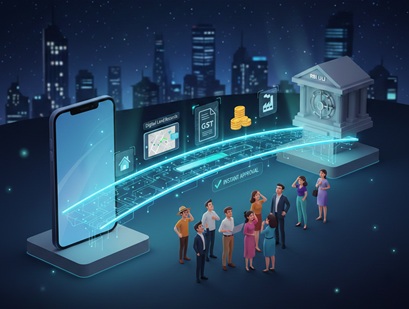
Why the “UPI for Loans” is India’s Next Big Financial Leap
In 2016, India changed how the world looks at payments with the launch of UPI. Today, in February 2026, we are standing at the edge of a similar revolution in the credit market. The Unified Lending Interface (ULI), a brainchild of the Reserve Bank of India (RBI), is officially moving from a pilot project to a national reality.
If you’ve ever applied for a home loan or a business loan, you know the struggle: a mountain of paperwork, physical visits to the bank, and weeks of waiting. ULI is here to end that.
What exactly is ULI?
Simply put, ULI is a Digital Public Infrastructure (DPI) that facilitates the “frictionless” flow of information between borrowers and lenders. While UPI moves money instantly, ULI moves verified data instantly.
It uses an “Open API” architecture. This means banks and fintech apps can “plug and play” into the system to fetch your financial and non-financial data—like land records, GST filings, and satellite imagery for crop assessment—directly from the source, provided you give your digital consent.
How ULI Solves the “Paperwork” Problem
Traditional lending is slow because data is “siloed.” Your land records are with the state government, your tax records are with the IT department, and your transaction history is with your bank.
ULI acts as a single window. When you apply for a loan:
- You provide your Aadhaar-based consent.
- ULI fetches the required documents digitally.
- The lender’s AI evaluates your creditworthiness in real-time.
- The loan is approved—sometimes in minutes instead of weeks.
The Impact: Who Wins?
The true power of ULI lies in Financial Inclusion. It targets the “missing middle”—the people traditional banks often overlook.
- For Farmers: In the past, verifying land titles took days. Now, ULI connects directly to state land registries. With satellite data, banks can even see crop health to approve agricultural loans instantly.
- For MSMEs (Small Businesses): Many small shops don’t have collateral. ULI allows lenders to look at cash-flow data (GST returns and digital sales) to offer “sachet-sized” working capital loans.
- For the “New-to-Credit”: If you don’t have a CIBIL score, ULI uses alternative data like utility bill payments or mobile recharge history to build your credit profile.
Safety First: Is Your Data Secure?
With such vast amounts of data moving digitally, privacy is a valid concern. The RBI has built ULI on the principle of “Consent-Based Architecture.” * Lenders cannot see your data without your explicit permission.
- The data flow is encrypted and follows the Digital Personal Data Protection (DPDP) norms.
- You have the right to “revoke” consent at any time.
The Road Ahead: 2026 and Beyond
As of February 2026, we are seeing ULI being integrated into popular banking apps and even third-party fintech platforms. The RBI’s goal is clear: to transition India from “Collateral-based lending” (where you need gold or property to get a loan) to “Information-based lending” (where your good financial behavior gets you a loan).
For the readers of KnowledgeBurst, the message is simple: The days of begging for credit are over. In this new era, your data is your biggest asset.
For more insights, read our other atricles: Daily Knowledge Burst in 100 words
1 thought on “The ULI Revolution”