
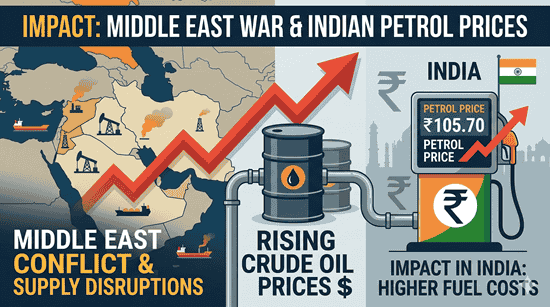
Global conflicts often have a direct impact on the world economy, especially when they involve oil-producing regions. The Middle East is one of the most important energy hubs in the world, and any military escalation there can significantly influence crude oil prices. For India, which imports a large portion of its oil requirements, such developments can directly affect petrol and diesel prices.
Let’s understand how the ongoing Middle East tensions could influence fuel prices in India.
🌍 Why the Middle East Is Important for Global Oil Supply
The Middle East accounts for a large share of the world’s oil production. Countries such as Saudi Arabia, Iran, Iraq, Kuwait, and the UAE are among the biggest crude oil exporters.
Another critical factor is the Strait of Hormuz, a narrow shipping route through which nearly 20% of the world’s oil supply passes every day. If conflict disrupts shipping routes or production in this region, oil supply can quickly tighten.
Whenever supply decreases or becomes uncertain, global crude oil prices usually rise.
📈 How Rising Crude Oil Prices Affect India
India imports more than 80% of its crude oil needs from international markets. This means that domestic fuel prices are closely linked to global crude oil prices.
When crude oil prices rise globally:
- Oil marketing companies pay more for imports
- Refining and transportation costs increase
- Petrol and diesel prices may rise domestically
Even if retail prices do not increase immediately, rising crude oil prices increase the financial burden on oil companies and the government.
🚢 Supply Disruptions During War
Wars can disrupt oil supply in several ways:
- Damage to oil infrastructure
- Reduced production in conflict zones
- Shipping disruptions in strategic waterways
- Sanctions on oil-producing countries
If the conflict affects major oil producers or transportation routes, global markets may experience supply shortages, pushing oil prices higher.
💰 Impact on Petrol Prices in India
If crude oil prices continue to rise due to geopolitical tensions, India could experience:
⛽ Higher Petrol and Diesel Prices
Fuel prices may increase depending on crude oil costs and government policies.
📦 Increased Transportation Costs
Higher fuel prices increase logistics costs, which can raise prices of goods and services.
📊 Inflation Pressure
Fuel is a key component of the economy. Rising fuel prices can contribute to overall inflation.
🪙 Possible Impact on the Indian Economy
The impact of rising oil prices extends beyond petrol pumps.
1️⃣ Higher Inflation
When transportation becomes expensive, food and essential goods may become costlier.
2️⃣ Pressure on Government Finances
The government may reduce fuel taxes or subsidies to control price increases.
3️⃣ Impact on Stock Markets
Certain sectors react strongly to rising oil prices.
Sectors negatively affected:
- Aviation
- Paint companies
- Chemicals
- Logistics
Sectors that may benefit:
- Oil exploration companies
- Energy sector firms
🛢️ Can India Control Petrol Prices?
Petrol prices in India are influenced by several factors:
- Global crude oil prices
- Rupee vs US dollar exchange rate
- Government taxes
- Refining and transportation costs
While the government sometimes adjusts taxes to stabilize prices, global crude oil prices remain the most important factor.
📊 What Should Consumers Expect?
If geopolitical tensions continue and oil supply is affected, the following scenarios are possible:
- Short-term volatility in crude oil prices
- Possible increase in petrol and diesel prices
- Inflationary pressure on the economy
However, governments and oil producers often take steps to stabilize the market if price spikes become extreme.
🧠 Conclusion
Global conflicts, especially in oil-rich regions like the Middle East, have a direct impact on energy markets. Because India depends heavily on imported oil, rising crude prices caused by geopolitical tensions can lead to higher petrol and diesel prices domestically.
While short-term price fluctuations are common during geopolitical crises, the overall impact depends on how long the conflict continues and whether global oil supply remains stable.
For consumers and investors alike, staying informed about global developments is essential to understand future fuel price trends.
Read our other articles: Crypto Tax Alert, The ULI Revolution